Event Details
Agenda
Travel
Abstracts
Event Details
Purpose
This workshop is sponsored by NIDDK’s intramural and extramural programs. It
builds on NIDDK-sponsored workshops that were held in 2009 and 2014 to
continue to explore the many emerging roles of brown and beige fat in human
metabolic health.
The workshop is dedicated to the memory of
Dr. Barbara Cannon (1946–2026)
whose body of work underlies the field of brown adipose tissue (BAT)
biology.
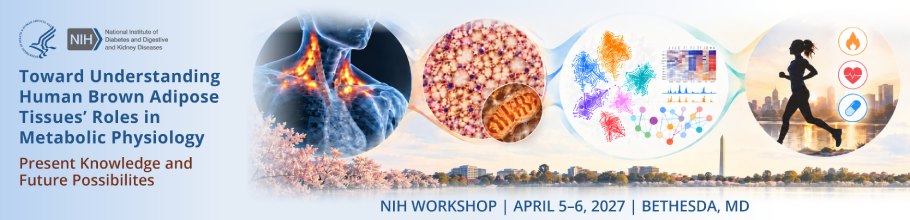
Brown adipose tissue (BAT) comprises depots of thermogenic fat that respond to
cold stress by generating heat through a variety of pathways, most notably
UCP1. BAT shares many characteristics with beige adipose tissue, which derives
from and resides within white adipose under certain physiological conditions.
These tissues are highly plastic and respond to internal hormonal and
metabolic signals, as well as environmental stresses. Brown and beige fat have
many other functions besides heat generation. Like other adipose tissues,
thermogenic fat secretes a variety of signaling molecules (adipokines) and
vesicles that carry information to other organs. It takes up and processes
substrates released by other tissues and contributes to the health of other
organs. Its regulation and contributions to whole-body metabolic health and
energy balance are currently under study.
This workshop will explore contemporary research focused on characterizing the
thermogenic adipose depots, including adipogenesis, activation, regulation,
metabolism, and function. Talks also will address BAT’s many modes of
receiving and transmitting information to other tissues. Speakers will explore
its emerging central role in metabolic health and disease and opportunities
for therapeutic targeting.
Organizing Committee
Aaron Cypess, M.D., Ph.D., M.M.Sc. (NIDDK Intramural)
Kong Chen, Ph.D., MSCI (NIDDK Intramural)
Maren Laughlin, Ph.D. (NIDDK Extramural)
Dhananjay (Jay) Gupta, Ph. D., M.S. (NIDDK Extramural)
Shingo Kajimura, Ph.D., Sc.D. (Harvard Medical School, Beth Israel Deaconess
Medical Center)
Yu-Hua Tseng, Ph.D. (Harvard Medical School, Joslin Diabetes Research Center)
Edward Melanson, Ph.D., FACSM (University of Colorado Anschutz Medical Campus)
Registration Deadline
March 28, 2027
Important Visitor Information
Due to recent changes to the campus access policy, participants who do not
have U.S. Citizenship or Lawful Permanent Resident (Green Card holder) status
will need to complete the VisitNIH pre-registration process at least 30 days
but no more than 60 days before the start of the event. To avoid missing this
deadline, please register for the workshop using the link above as soon as
possible and indicate your status. If VisitNIH pre-registration is required, a
staff member will reach out to help you through the process.
Agenda
Day 1: Monday, April 5, 2027
- 7:30 a.m. – 8:30 a.m.
- Registration
- 8:30 a.m. – 8:40 a.m.
-
Welcome
William Cefalu, M.D., National Institute of Diabetes and Digestive and
Kidney Diseases (NIDDK)
- 8:40 a.m. – 9:00 a.m.
-
Tribute to Dr. Barbara Cannon
Jan Nedergaard, Ph.D., D.Sc., The Wenner-Gren Institute, Stockholm
University, Sweden
- 9:00 a.m. – 9:20 a.m.
-
Keynote Address
C. Ronald Kahn, M.D., Harvard Medical School, Joslin Diabetes Research
Center
- 9:20 a.m. – 11:15 a.m.
-
Scientific Session 1: Human Brown Adipose Tissue (BAT) and Health
Moderator: Ricardo Samms, Ph.D., Eli Lilly and Company
- 9:20 a.m. – 9:40 a.m.
-
Human UCP1⁺ Adipocytes Link Adipose Architecture and Energy
Expenditure
Kirsty Spalding, Ph.D., Karolinska Institutet, Sweden
- 9:40 a.m. – 10:00 a.m.
-
BCAA Catabolism in BAT and Its Role in Metabolic Health
Shingo Kajimura, Ph.D., Sc.D., Harvard Medical School, Beth Israel
Deaconess Medical Center
- 10:00 a.m. – 10:20 a.m.
-
Peptide Hormones, β3-AR Agonists, and Cold Exposure as Approaches to
Activate Human BAT and Treat Metabolic Disease
Aaron Cypess, M.D., Ph.D., M.M.Sc., NIDDK
- 10:20 a.m. – 10:40 a.m.
-
Similarities and Differences in Cold-Induced BAT Between Healthy
Young Men (With and Without Obesity) and Women
Kong Chen, Ph.D., MSCI, NIDDK
- 10:40 a.m. – 11:00 a.m.
-
Brown Fat Activity in Women Is Dependent on Ovarian Function
Edward Melanson, Ph.D., FACSM, University of Colorado Anschutz Medical
Campus
- 11:00 a.m. – 11:15 a.m.
- Panel Discussion
- 11:15 a.m. – 11:30 a.m.
-
Break
- 11:30 a.m. – 12:45 p.m.
-
Scientific Session 2: Functional Brown Adipose Imaging in Humans:
Technological Challenges and Opportunities
Moderator: Edward Melanson, Ph.D., FACSM, University of Colorado Anschutz
Medical Campus
- 11:30 a.m. – 11:45 a.m.
-
Imaging Human BAT—From a Tool to Understanding the Function
Kirsi Virtanen, Ph.D., Human BAT Metabolism Research Group, University
of Turku, Finland
- 11:45 a.m. – 12:00 p.m.
-
Xenon-Enhanced MRI and CT for Multimodal Structural and Functional
Imaging of Human BAT
Tamara Branca, Ph.D., The University of North Carolina at Chapel Hill
- 12:00 p.m. – 12:15 p.m.
-
A Translational Perspective on the Role of BAT Thermogenesis in
Health and Disease
André Carpentier, M.D., University of Sherbrooke, Canada
- 12:15 p.m. – 12:30 p.m.
-
Adrenergic Control of Human Brown Adipocyte Operates Through Isoform
Switching
Søren Nielsen, Ph.D., M.Sc., University of Copenhagen, Denmark
- 12:30 p.m. – 12:45 p.m.
- Panel Discussion
- 12:45 p.m. – 1:50 p.m.
-
Working Lunch With Lightning Talks From Trainees Selected From Scientific
Abstracts
- 1:50 p.m. – 3:20 p.m.
-
Scientific Session 3: BATokines, Gut Microbiome, Interorgan Communication
Regulating Metabolism
Shingo Kajimura, Ph.D., Sc.D., Harvard Medical School, Beth Israel Deaconess
Medical Center
- 1:50 p.m. – 2:10 p.m.
-
Leveraging Large Human Cohorts to Uncover Novel Regulators of Brown
Fat
Paul Cohen, M.D., Ph.D., Weslie R. and William H. Janeway Laboratory of
Molecular Metabolism, The Rockefeller University
- 2:10 p.m. – 2:30 p.m.
-
TBD
Ricardo Samms, Ph.D., Eli Lilly and Company
- 2:30 p.m. – 2:50 p.m.
-
Gut Microbiota–Mediated Interorgan Communication Drives Beige
Adipocyte Induction During Dietary Protein Restriction
Kenya Honda, M.D., Ph.D., Keio University Human Biology
Microbiome Quantum Research Center, Japan
- 2:50 p.m. – 3:10 p.m.
-
Gut Microbiota–Adipose Communication in the Control of Thermogenic
Adipogenesis
Yuwei Jiang, Ph.D., University of Illinois Chicago
- 3:10 p.m. – 3:20 p.m.
- Panel Discussion
- 3:20 p.m. – 3:30 p.m.
- Break
- 3:30 p.m. – 5:00 p.m.
-
Scientific Session 4: Genetics (GWAS), Epigenetics, and Metabolomics of
Adipocytes in Health and Metabolic Disorders
Moderator: Aaron Cypess, M.D., Ph.D., M.M.Sc., NIDDK
- 3:30 p.m. – 3:50 p.m.
-
Adipose Tissue at Single-Cell Resolution: Where Do We Stand?
Evan Rosen, M.D., Ph.D., Beth Israel Deaconess Medical Center
- 3:50 p.m. – 4:10 p.m.
-
Deciphering Human Cervical Adipose Tissue at Single-Cell and Spatial
Resolution
Yu-Hua Tseng, Ph.D., Harvard Medical School, Joslin Diabetes
Research Center
- 4:10 p.m. – 4:30 p.m.
-
Therapeutic Oligonucleotides Targeting Adipose Thermogenesis
Michael Czech, Ph.D., Chan Medical School, University of
Massachusetts
- 4:30 p.m. – 4:50 p.m.
-
TBD
Ruth Loos, Ph.D., Novo Nordisk Foundation Center for Basic Metabolic
Research, University of Copenhagen, Denmark
- 4:50 p.m. – 5:00 p.m.
- Panel Discussion
- 5:00 p.m. – 6:00 p.m.
- Poster Session and Networking
- 6:00 p.m.
- Adjournment, Day 1
Day 2: Tuesday, April 6, 2027
- 8:30 a.m. – 8:50 a.m.
-
Keynote Address: Beyond Thermogenesis: Brown Adipose Tissue as a
Metabolic Signaling Organ
Philipp Scherer, Ph.D., Touchstone Diabetes Center, The University of
Texas Southwestern Medical Center
- 8:50 a.m. – 9:00 a.m.
- Q&A
- 9:00 a.m. – 10:50 a.m.
-
Scientific Session 5: Mechanisms of Thermogenesis
Moderator: Yu-Hua Tseng, Ph.D., Harvard Medical School, Joslin Diabetes
Research Center
- 9:00 a.m. – 9:20 a.m.
-
TBD
Bruce Spiegelman, Ph.D., Dana-Farber Cancer Institute
- 9:20 a.m. – 9:40 a.m.
-
Beyond Singular Effectors: The Futile Creatine Cycle From Molecular
Mechanism to Integrated Adipocyte Thermogenesis
Lawrence Kazak, Ph.D., Goodman Cancer Institute, McGill
University, Canada
- 9:40 a.m. – 10:00 a.m.
-
Nutrient Sensing and the Control of Adipocyte Energy
Expenditure
David Guertin, Ph.D., Chan Medical School, University of
Massachusetts
- 10:00 a.m. – 10:20 a.m.
-
Beyond UCP1: Branched-Chain Fatty Acid Metabolism in Adipose
Thermogenesis
Irfan Lodhi, Ph.D., Washington University School of Medicine in St Louis
- 10:20 a.m. – 10:40 a.m.
-
Alternative, Non-adrenergic Activation of the Human Thermogenic
Adipocytes
Alexander Pfeifer, Ph.D., Institute of Pharmacology and Toxicology,
University of Bonn, Germany
- 10:40 a.m. – 10:50 a.m.
- Panel Discussion
- 10:50 a.m. – 11:00 a.m.
-
Break
- 11:00 a.m. – 12:50 p.m.
-
Scientific Session 6: Non-adipocyte Cells Within Adipose Tissue; Impacts
on Metabolism
Moderator: Michael Czech, Ph.D., Chan Medical School, University of
Massachusetts
- 11:00 a.m. – 11:20 a.m.
-
Sympathetic Regulation of BAT and Systemic Metabolism
Lori Zeltser, Ph.D., Naomi Berrie Diabetes Center, Columbia University
Irving Medical Center
- 11:20 a.m. – 11:40 a.m.
-
Adapting to Metabolic Stress
Allen Saltiel, Ph.D., Institute for Diabetes and Metabolic Health,
University of California, San Diego
- 11:40 a.m. – 12:00 p.m.
-
Building and Maintaining the Thermogenic Niche: Cellular Networks
That Sustain Brown Fat
Farnaz Shamsi, Ph.D., NYU Grossman School of Medicine
- 12:00 p.m. – 12:20 p.m.
-
Immunometabolic Checkpoints Within the Adipose Tissue Niche
Prashant Rajbhandari, Ph.D., Diabetes Obesity Metabolism
Institute, Icahn School of Medicine at Mount Sinai
- 12:20 p.m. – 12:40 p.m.
-
Neuronal–Immune Crosstalk Regulates Thermogenesis and Metabolic
Aging
Annabel Wong, Ph.D., Diabetes & Metabolism Research Institute at
City of Hope
- 12:40 p.m. – 12:50 p.m.
- Panel Discussion
- 12:50 p.m. – 1:45 p.m.
-
Lunch
- 1:45 p.m. – 2:45 p.m.
-
Open Floor Discussion of Research Gaps and Opportunities
Aaron Cypess, M.D., Ph.D., M.M.Sc., NIDD
Yu-Hua Tseng, Ph.D., Harvard Medical School, Joslin Diabetes Research Center
Shingo Kajimura, Ph.D., Sc.D., Harvard Medical School, Beth Israel Deaconess
Medical Center
Kong Chen, Ph.D., MSCI NIDDK Ricardo Samms, Ph.D., Eli Lilly and Company
Michael Czech, Ph.D., Chan Medical School, University of Massachusetts
Edward Melanson, Ph.D., FACSM, University of Colorado Anschutz Medical
Campus
- 2:45 p.m. – 3:00 p.m.
-
Closing Remark and Thanks
Corinne Silva, Ph.D., NIDDK
NIH-NIDDK/DEM Leadership
- 3:00 p.m.
- Adjournment, Day 2
Travel
Hotel Accommodations
Hyatt Regency Bethesda Hotel
One Bethesda Metro Center
7400 Wisconsin Avenue
Bethesda, MD
20814
Telephone: (301) 657-1234 or (888) 421-1442
Reserve a Room
Government Room Rate
A limited block of sleeping rooms for meeting participants has been reserved
at the Hyatt Regency Bethesda Hotel. The rate is the prevailing government
rate of $276 per night for single occupancy, plus tax (13%).
The room block will be in effect at the Government rate only until
Wednesday, March 10, 2027, or until full, whichever comes first.
Any room reservations received after this date will be accepted on a space-
and rate-availability basis. Please be certain that the hotel provides you
with a confirmation number for your reservation.
Reservation Dates
Book your arrival date as Sunday, April 4, 2027, and departure as Tuesday,
April 6, 2027. If you require alternate dates, please contact
John Hare of The Scientific Consulting
Group, Inc. (SCG).
Check-in
When making a reservation, please provide your room and bedding preferences.
The hotel will assign specific room types at check-in, based on availability.
Please be advised that requests are not guaranteed. Check-in time is 3:00
p.m., and check-out time is 12:00 p.m.
Cancellations
If you need to cancel your reservation, please do so 48 hours prior to your
arrival date, or you will be charged a no-show fee for 1 night on your credit
card.
Directions to NIH from the Hyatt Regency Bethesda Hotel
The hotel is conveniently located directly above the Bethesda Metro Station
(Red Line). Guests can take the Metro one stop to the Medical Center Station,
which is adjacent to the NIH Gateway Center and provides direct access to the
NIH campus.
NIH Visitor Information
Information on visiting the NIH, campus maps, shuttle schedules, driving
directions, security, and more can be found on the
NIH Visitor Information
page.
Abstracts
Submission Deadline
February 5, 2027
Submitting Abstracts
Participants in the Toward Understanding Human Brown Adipose Tissues’
Roles in Metabolic Physiology: Present Knowledge and Future Possibilities are
encouraged to submit abstracts of their related research activities. In
addition to an opportunity to present their research in a poster session,
conference attendees will find additional career development and networking
opportunities with other researchers.
All abstracts must be submitted via email to John Hare of The Scientific Consulting
Group, Inc. with “Human BAT Abstract” in the subject line. Abstract submissions should be no longer than 250 words (not
including name and affiliation).
Download the abstract template. (DOCX, <1 MB)
Formatting Requirements
- The abstract should be an MS Word document typed single-spaced using Times New Roman font. Everything but the title should be in normal, 12-point font.
-
The abstract’s title should be
Bold, 16-Point, Title Case font and should clearly
represent the nature of the investigation.
-
On the line after the title, list the author’s first and last names,
degree, affiliation, city, state, and country.
-
Separate multiple authors with a semicolon, and underline the
primary author’s name (one primary author per abstract).
-
Use one blank line between the title and the body of the abstract and
between paragraphs.
-
The abstract file name should follow this format: primary author’s
LastName_FirstWordOfTitle (e.g., Zucker_Effects).
-
Please ensure that your abstract is the correct length and use 1-inch
margins.
-
Use of standard abbreviations is desirable (e.g., RBC), as well as standard
symbols for units of measure (e.g., kg, g, mg, mL, L, and %). Place a
special or unusual abbreviation in parentheses after the full word the first
time that it appears. Use numerals to indicate numbers except to begin
sentences. Do not use subtitles (e.g., Methods, Results).
-
Simple tables or graphs may be included; however, they must fit within the
designated abstract space of one page.
Organize the body of the abstract as follows:
- Statement of the purpose of the study/program/project
- Statement of the methods used
-
Summary of the results presented in sufficient detail to support the
conclusion
- Statement of the conclusions reached
Poster Presentations
Poster presentations will be displayed on 4-foot-high by 6-foot-wide poster
boards. Pushpins and Velcro will be provided onsite.
All presenters must register in advance for the conference.
Notification
All submitters will be notified of acceptance by March 5, 2027.