
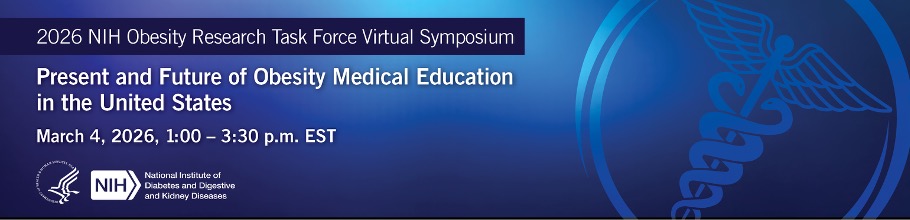
2026 NIH Obesity Research Task Force Virtual Symposium: Present and Future of Obesity Medical Education in the United States
Registration
Event Details
Meeting Resources
Purpose
This National Institutes of Health (NIH) Obesity Research Task Force (ORTF) Virtual Symposium will present information focused on the current state and future of obesity medical education in the United States.
Objectives
This workshop will convene obesity medicine specialists and educators to discuss the current state and future of the following:
- Education and training in obesity medicine for medical students, residents, and fellows in the United States
- Certification pathways in obesity medicine for physicians, registered dietitian–nutritionists, and advanced practice providers
- Continuing education opportunities in obesity medicine for health care professionals, including exercise physiologists, fitness trainers, and pharmacists
This workshop also will present input from major medical professional societies and the pharmaceutical industry, as well as the patient perspective that informs all aspects of workforce education in obesity medicine.
Background
Obesity is now recognized as a chronic progressive disease associated with the development of additional diseases, such as diabetes, cardiovascular disease, kidney diseases, and cancer. Obesity is a modern epidemic, affecting 40% of adults and 20% of children in the United States. The development of novel, highly effective obesity medications (e.g., glucagon-like peptide-1 [GLP-1] receptor antagonists [RAs], such as Wegovy®, and glucose-dependent insulinotropic polypeptide [GIP]/GLP-1 dual RAs, such as Zepbound®) have been transformative in the care of people with obesity, resulting in substantial weight loss and improvements in several obesity-associated complications and diseases.
Long-term medical management of obesity is complex, often involving not only a focus on weight loss and maintenance through behavioral, surgical, and pharmacological approaches, but also consideration of the interplay with social, economic, environmental, and mental health factors (e.g., community norms, resource availability and access, stigma, discrimination). In addition, patient-driven goals may center on quality-of-life improvements as much as the weight loss and its associated health benefits. Addressing this complexity requires specialization, continuing education, experience, and dedicated time and resources, which may not be available to many primary care professionals. However, there are too few certified obesity medicine professionals to care for the many people with obesity and who are overweight. To address this shortage, it is necessary to examine the current state and future of obesity medical education and training for the larger community of medical professionals.
Despite the health risks that obesity poses, the provision of clinical obesity care currently is inadequate, owing to multiple clinician- and health care system–based barriers. One of the most frequently cited barriers is the need for more undergraduate and graduate medical education training in obesity management. The consensus among many studies is that obesity curricula are inadequate, and most medical students and residents are not well prepared to treat patients with obesity. This lack of preparedness poses a challenge to medical professionals who need to provide obesity care in their normal practice and keep abreast of the rapid pace of scientific advances within the field. Similar challenges exist among other specialized health care professionals, including registered dietitians, advanced practice providers, and exercise specialists. Although specialized physician fellowship training in obesity is expanding quickly and now encompasses 33 obesity medicine fellowships across the country, more needs to be done. The American Board of Obesity Medicine, launched in 2011, reports 11,794 certified diplomates as of December 2025, up from 4,148 in 2020. Multiple stakeholders, including professional societies and pharmaceutical companies, have an important role in obesity education. This workshop will highlight the progress made in obesity medical education and report on plans for the future.
Planning Committee
- Robert F. Kushner, M.D., M.S., DABOM, Northwestern University Feinberg School of Medicine
- Maren Laughlin, Ph.D, National Institute on Diabetes and Digestive and Kidney Diseases, NIH
- Eric J. Shiroma, Sc.D., M.Ed., FACSM, National Heart, Lung, and Blood Institute, NIH
Registration Deadline
March 3, 2026
Event Logistics
Registration
Location
Webinar
Registered participants will receive a link to join the webinar via email prior to the date of the event.
Contacts
Program Contacts
Maren Laughlin, Ph.D.
NIDDK
Eric J. Shiroma, Sc.D., M.Ed., FACSM
NHLBI
Meeting Logistics
John Hare, M.S., CMP, CGMP, DES
The Scientific Consulting Group, Inc.